
Shari Foos ‘97 (Los Angeles, MA in Clinical Psychology) has spent decades exploring how creativity, storytelling, and human connection can help people better understand themselves and one another. Now, the ideas at the center of her work are becoming a book.
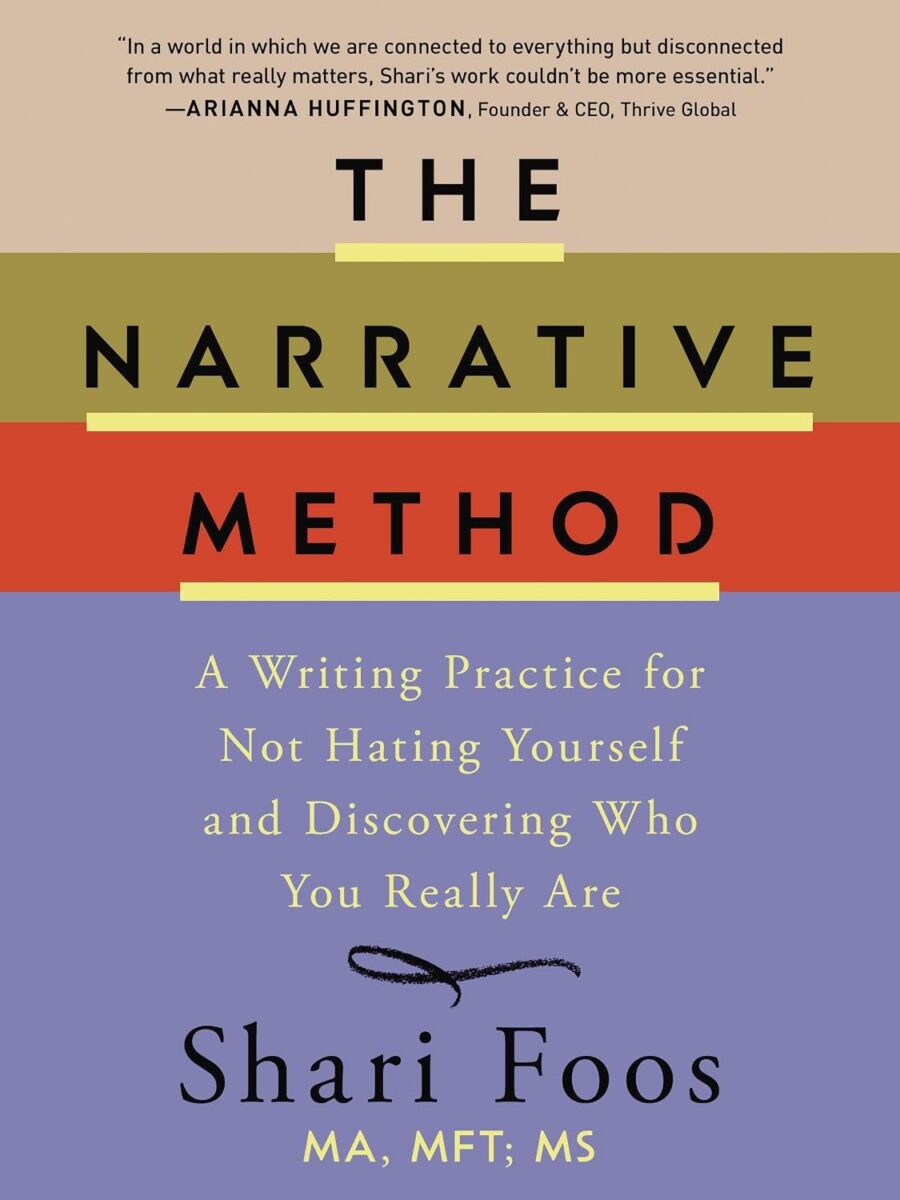
Foos’ forthcoming The Narrative Method: A Writing Practice for Not Hating Yourself and Discovering Who You Really Are will be published by Harper Celebrate on April 6, 2027, and is currently available for preorder. The 240-page book guides readers through a 13-week writing practice designed to encourage self-discovery, creativity, and greater connection with others.
The book is an extension of The Narrative Method, the nonprofit organization Foos established in 2012. Utilizing writing prompts, facilitated gatherings, and group experiences, The Narrative Method employs creative expression to cultivate awareness, empathy, and connection. Currently, the organization provides both online and in-person salons, along with programs for schools, social service agencies, veterans, educators, and various other communities.
Rather than approaching writing primarily as a craft to be evaluated or perfected, Foos’ method encourages participants to use writing as a way to explore their own experiences without judgment. In the forthcoming book, readers move through daily prompts and exercises focused on ideas such as identity, creativity, gratitude, communication, shifting perspective, self-acceptance, and what Foos calls “relational mindfulness.” The goal, according to the book’s description, is not necessarily to become a better writer, but to use writing as a vehicle for developing a deeper relationship with oneself and others.
Foos earned her MA in Clinical Psychology from Antioch University Los Angeles in 1997 and later earned an MS in Narrative Medicine from Columbia University. She is a licensed Marriage and Family Therapist as well as an educator, activist, writer, and improvisational artist. Before becoming a therapist, Foos worked as a television and radio writer, comedian, and host of salons and events that brought artistic and intellectual communities together for conversation and creative exchange.
In 1999, Foos and David Tripp co-founded the Bridge Program at Antioch University Los Angeles. Created to expand access to higher education, Bridge provides free, university-level humanities education to adults who otherwise might not have the opportunity to attend college. The interdisciplinary program has included study in literature, philosophy, art history, and writing and has served hundreds of students since its founding.
In 2024, the Bridge Program celebrated its 25th anniversary, bringing together students, alumni, faculty, staff, and supporters to reflect on the program’s impact. For Foos, seeing the program continue for a quarter century after its founding was particularly meaningful.
“To see a lifelong dream thriving after 25 years is the next best thing to healing the wound that provoked it,” Foos stated during the anniversary celebration.
The philosophy behind Bridge—creating opportunities for people whose experiences and potential are often overlooked—also runs through Foos’ later work. The Narrative Method creates spaces where participants can express themselves without criticism or judgment and listen to others on their own terms. Foos has described the work as a response to an increasingly disconnected culture, using storytelling and creativity to foster genuine human connection.
Her forthcoming book brings that work to a wider audience. Structured around 13 concepts of The Narrative Method, it asks readers to examine the stories they have absorbed about themselves, experiment with new perspectives, and use imagination as a tool for change. Among the concepts are “Kaleidoscoping,” which focuses on expanding perspective; “Radical Gratitude”; “Sounds & Signals,” centered on communication; and “Narrative A.W.E.,” Foos’ framework for awareness, wonder, and empathy.
The Narrative Method: A Writing Practice for Not Hating Yourself and Discovering Who You Really Are signifies a continuation of a career grounded in the belief that opportunities for individuals to share their stories, and to have those stories received without judgment, can fundamentally alter self-perception, interpersonal understanding, and perceptions of possibility.