
On a typical Monday afternoon, while the rest of the world is shifting into the “overwhelm” of the work week, a small but dedicated digital sanctuary begins to flicker to life. Since 2020, students, faculty, and alumni across Antioch University have carved out this hour to engage in Messy Conversations. This grassroots weekly conversation collective remains steadfast as a rare, defiant model of institutional persistence and radical honesty.
Originally developed through the Undergraduate Studies programs at the Los Angeles, Seattle, and Santa Barbara campuses, Messy Conversations was open to participation across the University from the beginning. Over time, some conversations also expanded to include members of the broader community, while others remained focused on topics specific to Antioch. The sessions are an opportunity to connect across Antioch with those invested in building an anti-racist community at the University, in the community, and in the larger world. Messy Conversations generally begins week two of each quarter, providing a time for what the organizers describe as “self-reflection, relearning of history, and relationships of support, anti-racist intention, and action.”
The Inception: A Felt Need
Messy Conversations is inextricably linked to the collective trauma of 2020. Following the murders of Ahmaud Arbery, Breonna Taylor, and George Floyd, the rekindling of the Black Lives Matter movement forced a reckoning across the United States. Longtime faculty member David Tripp observed his students struggling in real time. “It was a heavy time,” he says. “I had students—including a few who were undocumented—politically aligned with BLM but also worried about their safety while they were in class on Zoom. Protests were happening literally right outside their doors. We could hear yelling, and protesters were banging on the students’ doors. It was an intense time for all of us in different ways; definitely a challenging classroom environment.”
During a University-wide faculty meeting, he floated the idea of a place where the community could come together for hard conversations. That eventually grew into Messy Conversations.
“I think as long as we’re in conversation, things will probably be all right,” says Tripp. “That doesn’t mean things will be easy. If you’re going to be in real conversation, then you have to be willing to be in messy conversations. We didn’t want to create a performative conversation space. We wanted a space where we could come together and bring whatever we were wrestling with and whatever challenges we were facing into that space and hold one another accountable while offering support.”
Tripp views the project as part of Antioch’s long tradition of “responses to felt need.” The “anarchic energy” of Messy Conversations is a testament to faculty, staff, and student willingness to collaborate on grassroots initiatives.
“If you’re going to be in real conversation, then you have to be willing to be in messy conversations. We didn’t want to create a performative conversation space.”
Seattle faculty member and Messy Conversations organizer Sara Beth Lohre shares Tripp’s sentiment. “Messy conversations was just how we started,” she says. “It was so exciting and easy, but also very Antiochian. It’s a couple of people sitting together saying what’s needed, and we don’t know the whole situation, and we can’t make something that addresses what everyone needs, but we don’t feel good about the fact that the administration hasn’t said much.”
The Architecture of Turning Together
At the heart of Messy Conversations is a shift from traditional lecturing toward what Los Angeles faculty member and Messy Conversations organizer Rosa Garza-Mourino describes as “civic learning.” The Latin root of conversation—conversare—means “turning together,” which Garza-Mourino sees as “a radical act of accountability and dignity, qualities of self-governance that are teachable and are practiced and modeled in courses and community-based learning.” As she explains, “Once you identify where the boundaries are in a situation, then you can be totally free inside of it.”
The structure reflects intimacy over formality. Typically, a session begins with a half-hour discussion among panelists, followed by an open invitation for attendees to join in. It models dialogue and invites everyone to “have a seat at the table,” a practice identified at the core of civic learning.
Santa Barbara faculty member and longtime Messy Conversations organizer Anna Kwong, who recently retired from Antioch, emphasizes the importance of a listening-first approach. “We let people talk, and we listen,” she says. “All around us, we hear polarized, heated arguments—one side on the left, the other on the right. Who is right? Some may say, ‘I am right. I’m not going to listen to you.’ But our approach is, ‘Let’s listen. You may disagree, but let’s listen.’”
Anti-Racism as a Permanent Center
Messy Conversations comes out of the belief that ongoing, sustained conversations, particularly about race and anti-racism, are critical at Antioch and across our country. While Messy Conversations explores a range of topics, its primary work is to be a dedicated space for Antiochians to engage in meaningful dialogue about race, racism, and the anti-racism movement.
Clarence R. Williams ’22 (Los Angeles, BA), has been deeply involved in Messy Conversations for half a decade now. But he explains that he was originally a reluctant participant. Los Angeles faculty member and Messy Conversations organizer Elaine Parker-Gills encouraged him, as a student, to attend Messy Conversations. “This was just after George Floyd,” explains Williams. “I thought, I don’t really want to be bothered. But this call from Dr. Gills, saying, ‘Please come. Just sign on. It’s on Zoom. So begrudgingly, I went in, kicking and screaming.” It was a meaningful step. As Williams says, “I came to Messy Conversation, and I never left.”
Williams eventually brought his extensive background in Broadway, television, film, service in two different White Houses, and work with the Congressional Black Caucus to the team. He shared with Messy Conversations his lived experience growing up in the Jim Crow South, as well as his professional time in Washington, DC, before he moved to Los Angeles. Williams says, “Much of our conversation centered on the far-reaching impact of the George Floyd situation. Even before I joined the planning committee, as a student, I often felt very emotional and deeply triggered by the reality of my lived experiences. But I was brave enough, as Maya Angelou would say, to share those experiences in the safety of that space.”
Similarly, Nabi Supetran ’20 ’24 (Los Angeles, BA; Seattle, MA), who previously served as a work-study student assigned to Messy Conversation, says that how her involvement in the project helped her develop cultural agility. She got better at “noticing topics I’m not so familiar with, and what happens in my body… and just noticing there’s more work for me to do personally and professionally.” Supetran eventually facilitated sessions on “Third Culture Kids,” a term to describe individuals raised in a culture other than their parents’ or the culture of their country of nationality. It was meaningful to have space to discuss this unique, hybrid identity.
Messy Conversations was founded “as a place for those who have to continue to do anti-racist work together in the world, in classrooms, and out in the larger community,” says Lohre. “It is a charging station for activists who find the work both a source of joy and stress.”
Messy Conversations has been built to endure. This persistence was the result of a deliberate, daily commitment by a core group of faculty and students to ensure that the work did not “die down” once the initial protests ended.
Antioch Reference and Instruction Librarian Asa Wilder, who joined Messy Conversations in 2022 says, “I think one of our biggest triumphs is the fact that we are still going. After the summer of 2020, many universities and other institutions launched projects focused on antiracism, but we can see that many of those projects have been abandoned, erased, or forgotten. Those who began Messy Conversations were very deliberate in making sure this project did not suffer that same fate, and I am very grateful to them for the foundation they laid those years ago.”
A Retrospective on Resilience
On October 20, 2025, the team organized “Messy Turns Five,” a chance to commemorate and reflect on this anniversary. The event was not merely a celebration of longevity, but a profound interrogation of a half-decade spent in the trenches of grassroots anti-racist work. As the community gathered across time zones, this milestone offered a rare, unvarnished look at the resilience required to sustain radical dialogue in a world prone to performative gestures.
Over time, there’s been a significant collective interrogation of what it means to be “messy” in a civil context. “Messy” represents vulnerability over order, characterized by a willingness to bring unresolved thoughts and raw emotions to the table without fear of being labeled “unprofessional.” It also signifies a refusal of performativity, prioritizing “real talk” and truth-telling over institutional optics. Furthermore, it represents collective responsibility, recognizing that social justice work requires a “meaningful mess” where everyone has a seat at the table and shares the burden of the conversation.
One of the most celebrated elements of Messy Conversations is the “after-hour” or the “afterglow” practice in which many participants stay on Zoom for 30-60 minutes after the formal conversation (and recording) ends. This unstructured time is essential for true engagement. Referred to as “doorknob conversations,” a term borrowed from clinical practice to describe the vital information shared just as someone is about to leave, these unrecorded, informal moments are often where the most radical and challenging ideas are frequently aired.
“Messy” represents vulnerability over order, characterized by a willingness to bring unresolved thoughts and raw emotions to the table without fear of being labeled “unprofessional.”
The impact of the collective has been deeply personal and transformative for participants. For Supetran, it models “authenticity, openness, and learning together.” For Jacqueline Rose ’22 ’25 (Online, BA; Los Angeles, MFA), the first student member of the planning team, the dialogues serve as an emotional anchor and a catalyst for her artistic practice. She says she’s often used session recordings as a prompt for a poem or a reflective moment for a story. For Tripp, the Conversations are grounded in a “plurality of resistances,” a term he draws from the work of philosopher and political activist Michel Foucault, to emphasize that every act of defiance, from making music to participating in a “messy” dialogue, is a necessary part of producing “cleavages in a society.”
In reflecting on the necessity of this work, Kirsten Grimstad, a founding Messy Conversations planning committee member and former co-chair of the Los Angeles Undergraduate Studies department, expresses profound “frustration and sorrow” regarding current signs of cultural backlash. She says that “turning back the clock is particularly vivid and horrifying” as books intended to foster historical reckoning are being banned, and individuals who espouse racist ideas are tolerated and even elevated to positions of power and authority. She says that being surrounded by committed people who live these values is what keeps her hope alive.
A Legacy of “Meaningful Mess”
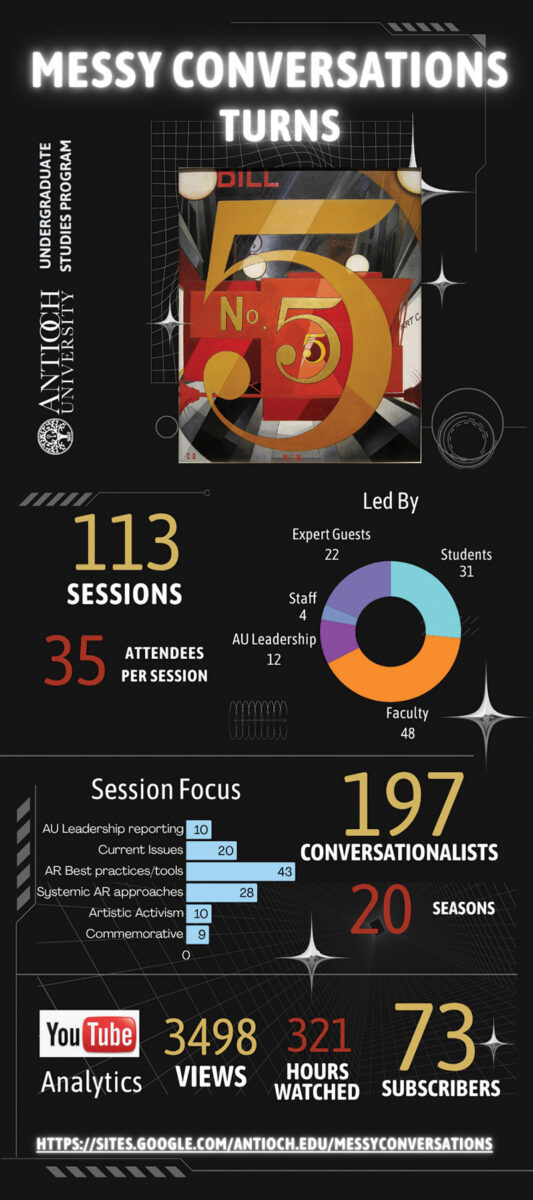
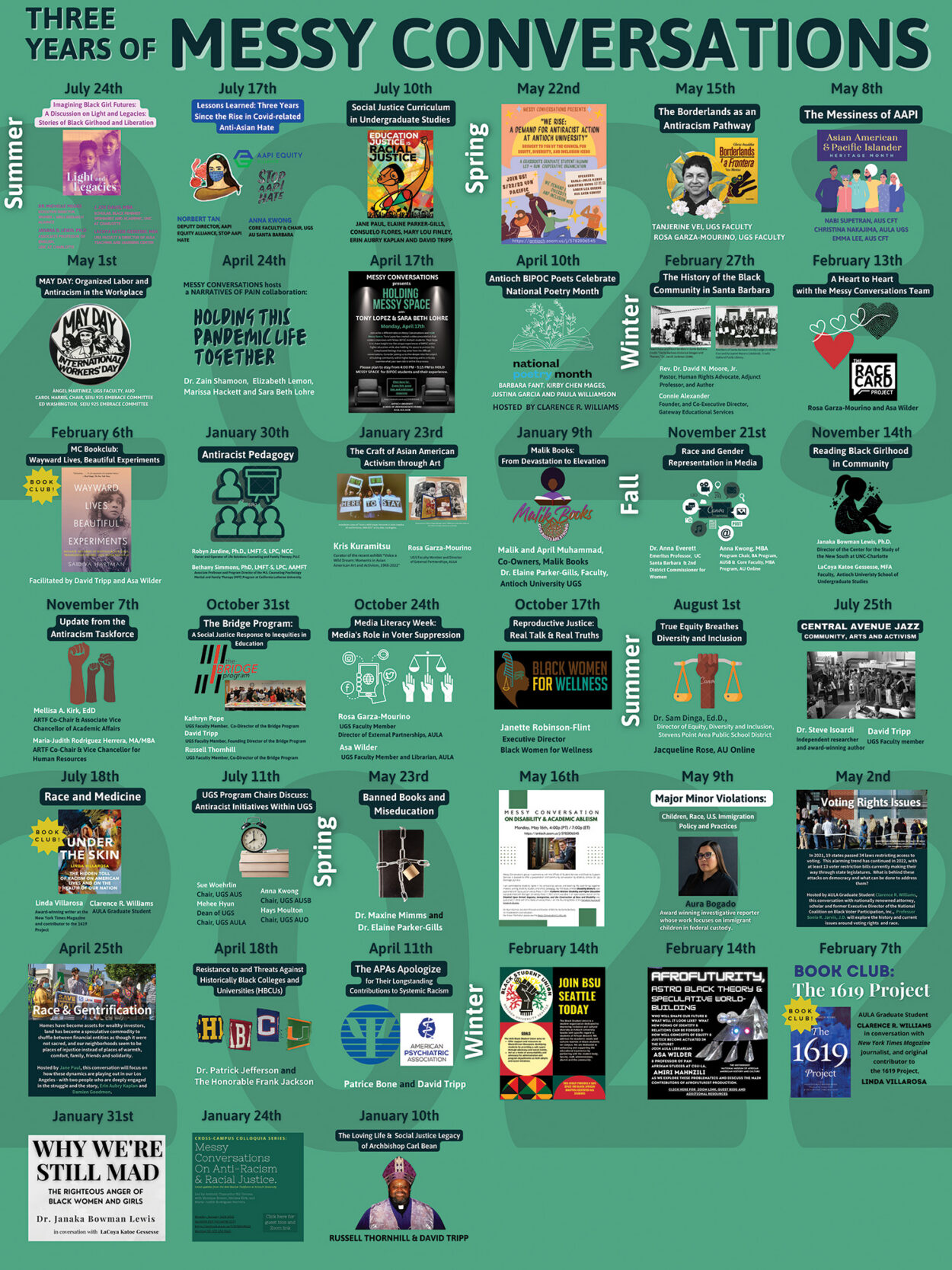
By the time of its October 2025 Anniversary, Messy Conversations had hosted 113 sessions across 20 seasons, engaging 197 unique conversationalists and over 32 guest organizations. Those numbers continue to grow.
Messy Conversations offers an expansive digital archive of resistance, which serves as a permanent, living curriculum for the Antioch community with recorded sessions organized not only by season, but also into 21 thematic playlists ranging from “Antiracism and the Humanities” (32 videos) to “Antiracism and Political Sciences” (25 videos), “Antiracism and the Arts” (20 videos), “Antiracism and Urban Studies” (19 videos), and “Antiracism and Spirituality” (17 videos). Each recording in the archive is a brick in the foundation of a community that refuses to retreat into the safety of silence.
As Messy Conversations enters its sixth year and 22nd season, the focus has shifted toward sustainability and “passing the baton.” Tripp holds a deep-seated belief in the necessity of new leadership. “My hope, personally, has been that some people will want to join the planning team and sort of just take it over, take it in some new direction,” he says. “I learned this a long time ago. Just because you start something doesn’t mean you should run it, and there’s wisdom in getting out of the way and letting new energy, new blood come in, and letting things unfold in ways that you couldn’t begin to imagine.”
Messy Conversations stands as a model of what is possible when a community refuses to be silenced. As Williams says, “I celebrate Antioch for being brave enough to start Messy Conversations, because so many institutions have erased spaces to engage around real-life issues.”
Perhaps Kwong captured it most beautifully in her benediction at the 5th Anniversary celebration, when she said, “May our efforts continue not just for the next five years, but for the next 50 years. Because the pursuit of equality, equity, and justice is not just a project with an end date—it is a promise that we must keep alive for generations to come.”
Note: Quotes in this story include interviews conducted by Jasper Nighthawk in 2023 and 2024, a recorded event from 2025, along with interviews conducted this year by the author.