When Michael Cheever first learned that he was the 2025 recipient of the Distinguished Alumni Award at Antioch University Seattle, he didn’t quite believe it. “It was obviously a very proud moment, but it was a voicemail, and then an email, and I think I had to read it three or four times to truly grasp what they were saying and what it meant,” Cheever explains. But once it sank in, he felt honored and seen. As he puts it, “I was incredibly surprised, and I would say proud. Knowing that I was the first in my family to go to school, education has always been important to me. To receive that award—I think it was a kind of cherry on top of what I already thought was a success.”
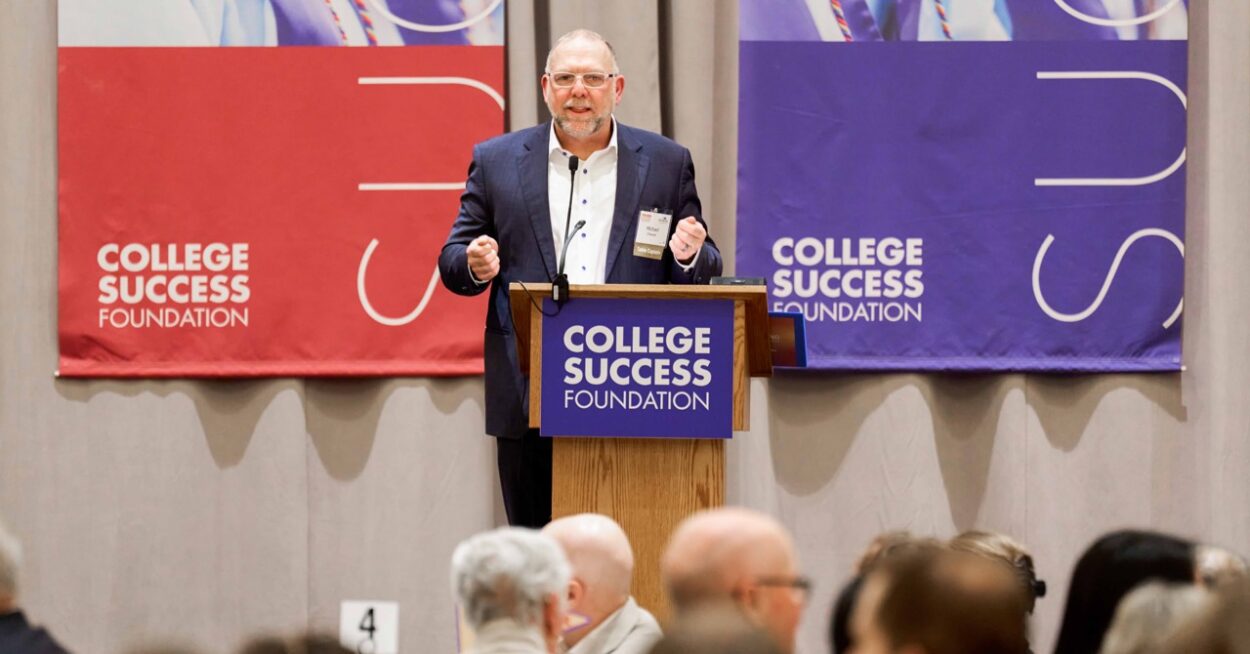
The Distinguished Alumni Award is given out every year during Commencement at Antioch University Seattle. It’s a chance not only to cheer on the new graduates poised to make their mark but also to recognize the achievements of a previous alum who has made great strides in their field and in the world. The award reminds students both current and graduating that they too can carry forward the Antioch mission.“We look at alumni who have made contributions to the community—to the larger community as well as the Antioch community—and really uphold the principles and values in our mission at Antioch,” says Associate Provost Sue Byers. Last year, the honor was bestowed on BA alum Michael Cheever, an Antiochian who has used his own college experience as a means to helping others achieve their dreams of participating in higher education.
Since 2014, Cheever has worked with the College Success Foundation, an organization committed to coaching and supporting students from low socioeconomic backgrounds in order to help them prepare for and graduate from college and become leaders who can help create what the organization describes as a “more just and equitable society.” During his time there, Cheever has held a number of positions including Interim CEO and Executive Vice President of External Relations before becoming the President and CEO of the foundation. At the same time, the foundation has grown, now helping students throughout Washington State and Washington, D.C.
Cheever was drawn to the College Success Foundation and its mission of expanding opportunities for lower-income students and breaking generational cycles in part because he knows firsthand how much work it can be to get a college degree.
“I certainly had a non-traditional path, on the education front,” Cheever says. “I grew up, a kid born in the Mojave Desert of California. But I didn’t really have a lot of support or things like that to talk about college, to plant that seed and other things. So after I finished high school, I joined the military and went overseas.”
Cheever spent years in the Navy, stationed in Italy and later the Middle East. It was during his time in the military that he had an experience that opened his eyes to how different someone’s conditions could be simply because of the support they were or were not receiving.
“There was a moment where we were paired up with members of the Pakistani Army, and I was paired with a gentleman named Muhammad for a couple of nights,” he says. “Speaking with him, I found out the U.S. government was paying him I think a dollar or two a day to protect our base. He had five sons at home in Pakistan. So, he was sending most of his money home to take care of his family. And while he was working at the base he was sharing an apartment with eight or 10 other gentlemen. And that really hit me. I had all the equipment and infrastructure that one could imagine from the U.S. military, and here’s a man that just had a blue jumpsuit and a big knife to do the same job.”
For Cheever, this revelation led to some meditations on fate and inequality. “It was just that I happened to be born in America and he happened to be born in Pakistan that created the difference in our situations,” he says. “That really was kind of a defining moment that struck me of privilege and luck. And it’s always resonated and stayed with me that not everyone had that, and we should collectively work to make the world a better place and support one another. Life is already hard with the best of circumstances, right?”
While he was serving in the Navy, Cheever pursued his education by taking correspondence courses one at a time. After returning to the United States, he moved to Seattle and decided to continue to work toward a degree. He chose to enroll at Antioch.
“What really drew me to Antioch was the flexibility with the credits I had earned from other institutions and from my time in the military, and the class size to faculty ratio,” says Cheever. “I was older and had already been through the military. I wasn’t 19 or something, so I appreciated having more of that kind of access to the faculty and experts. That really drew me to go there.”
Cheever graduated in 2010 with a BA in Leadership and Organizational Studies. He was the first in his family to graduate from college.
Four years later, he started working for the College Success Foundation. He was drawn to give back to students like himself—or like the Pakistani man whose situation resonated so intensely with him. And his experiences at Antioch have continued to play a pivotal role. Even now, says Cheever, he’ll find himself going back to notebooks from classes he took at Antioch to reinforce his understanding of situations he encounters in his work. This is just one more reason he says he appreciates the time he spent at Antioch University Seattle.
“Antioch instilled in me the power of curiosity, courage, compassion, and community—values I carry with me in all that I do,” Cheever said as part of his acceptance speech for the Distinguished Alumni Award. “This recognition renews my commitment to give back, lift up students, and collaborate on positive change in our communities.”