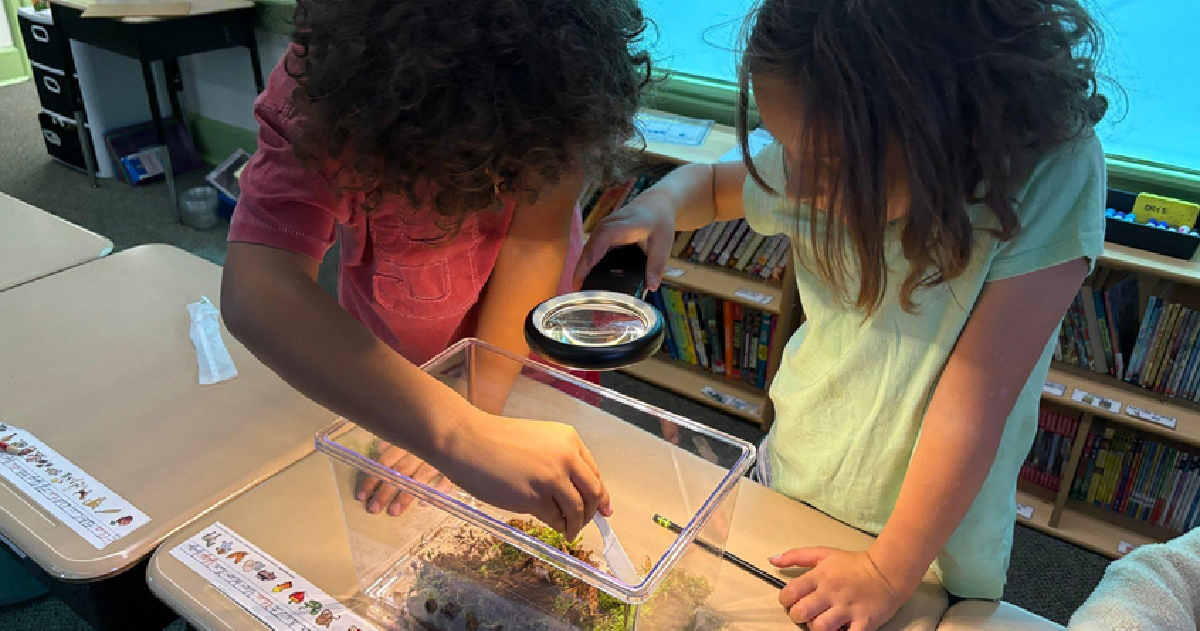

(Photo above: Third-grade students examine materials for their miniature ecosystems as part of the 2026 Biosphere Challenge.)
What happens when forest soil, moss, decaying leaves, and hundreds of tiny organisms are sealed inside a transparent container for two weeks? Will the organisms survive? How will the ecosystem change? And what can a miniature world reveal about the larger world we live in?

These are some of the questions that elementary school students across southeastern Vermont are looking at as part of the 2026 Biosphere Challenge. The Challenge is an exciting new science initiative created by Antioch University Professor Emeritus and alum Jimmy Karlan ‘82 (New England, MST).
The challenge brings hands-on environmental science to PreK–6 classrooms across six schools in the Windham Southeast Supervisory Union. Through Karlan’s curriculum , the students are creating 130 miniature ecosystems to explore biodiversity, decomposition, food webs, and the interconnections of living things.
For Karlan, who spent 25 years as a core faculty member in the Environmental Studies Department at Antioch and who ran the Science Teacher Certification Program and taught a highly experiential Research Design course in the doctoral program, the initiative is very much in keeping with his lifelong approach to education, which has always been through inquiry, experimentation, and discovery.
“The idea behind these challenges is simple,” said Karlan. “Give children something genuinely interesting and fun to investigate, provide the tools and encouragement they need, and then make room for their curiosity to lead the way.”
A Science Experiment Decades in the Making
Although the 2026 Biosphere Challenge is part of a new series of district-wide curricula created pro bono by Karlan, its origins go back over 30 years.
Karlan developed a Biosphere Challenge as part of his doctoral research at Harvard (Children’s Ecological Concepts and Theories: 5th & 8th Graders’ Ideas About the Nature of Nature, 1995). At that time, Karlan probed into students’ thinking as they created what they thought was necessary to sustain multiple generations of spiders in a sealed container for as long as possible. It was subsequently covered in Green Teacher (a 2000 article entitled ‘The Biosphere Challenge: Developing Ecological Literacy’ and another in 2001, with Antioch Science Teacher Certification student Hannah Root, examining the potential of mini-biospheres for investigating climate change and the natural cycles that underpin it).
The idea is an educational philosophy that Karlan developed as a grad student at Antioch and which he carried with him throughout his teaching career.
“It was at Antioch where I learned to free myself from the didactic, impersonal ways I had been taught and to consider teaching and learning as a dynamic creative process,” Karlan shared in a previous Common Thread interview.
That philosophy still underpins his work today, with students given the opportunity to ask their own questions, test their own ideas, and discover the principles of science for themselves.
Exploring Life Inside a Miniature World
For this year’s challenge, the students are building miniature ecosystems with forest soil, moss, and leaves, and four different organisms: springtails, dwarf white isopods, white worms, and predatory mites. Once the organisms have been introduced to their new environments, the students observe their system with large magnifiers and air quality monitors.
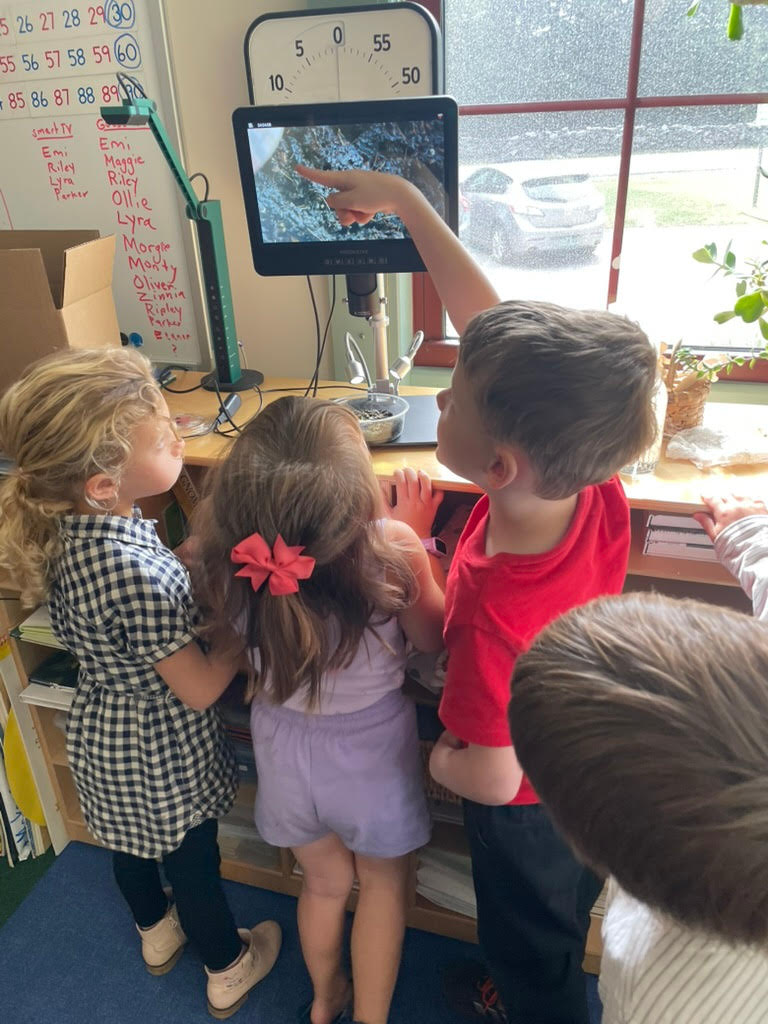
The students’ excitement builds when they seal their biospheres for two weeks, creating miniature worlds that must sustain themselves without outside intervention. Throughout the process, the students consider how temperature, humidity, and CO2 levels might change, whether the organisms will survive, and what their observations reveal about the relationships that sustain life on Earth.
The challenge also features puzzles and a district-wide story that students must combine into a story that makes sense. The participating classrooms can win the scientific supplies used in the challenge (terraria, magnifiers, air quality monitors, etc.) as well as a ‘Shrimp Mobile’ (a one-gallon aquatic system with Hawaiian volcano shrimp that can live for 20 years or more). However, everyone’s success depends on the success of all the other participating classes at all the schools.
Teachers say the experience has brought new excitement to their science lessons.
“Our experience with the Biosphere Challenge has been awesome,” said Chris Szpila, a fifth-grade teacher at Academy School. “This is the first challenge that has tied perfectly with my current science unit and standards.”
Szpila described the students’ enthusiasm as they discovered the tiny organisms inside their ecosystems after being sealed for two weeks, recalling “lots of high-fiving and joy” during the experience.
Inspiring Curiosity Beyond the Classroom
The Biosphere Challenge is the fourth in Karlan’s series of district-wide science initiatives designed to get the kids out and exploring worlds that would otherwise be invisible to them
The series began with the 2024 Wildlife Camera Challenge, which introduced students to the animals sharing their school grounds. Students earned up to two solar-powered wildlife cameras for their school if they solved all the program’s challenges. The initiative grew out of Karlan’s own interest in the wildlife around his house in Guilford, VT, which he was documenting with trail cameras.
In 2025, the Very BIG Tiny Challenge introduced students to microscopic worlds. Classrooms were given high-end large-screen digital microscopes capable of taking photographs and videos. Students had to use their “loaned” microscope to solve a series of challenges in order to earn their microscope for keeps. Forty classrooms are now equipped with digital microscopes.
The 2025 Bird’s-Eye View Challenge followed, engaging students in studying birds and their nesting behaviors while providing seven schools with 20 nesting boxes equipped with solar-powered cameras. Like the Very BIG tiny Challenge, classes were given nesting boxes with solar-powered video cameras at the onset and had to solve a series of challenges to earn them for keeps.
Together, these initiatives have provided schools with lasting scientific equipment while encouraging students to develop observation, investigation, and problem-solving skills.
Brin Tucker ‘04 (New England, MEd), Director of Curriculum and Assessment at WSESU, said the program demonstrates the value of connecting scientific concepts with real-world experiences.
“WSESU is committed to embedding science instruction, design principles, real-life application, and fostering engagement through hands-on learning,” said Tucker. “The Biosphere Challenge weaves together these essential educational components while making complex science concepts accessible, concrete, and a memorable elementary school experience.”
Karlan says that there’s nothing like working with a fellow Antiochian on projects like these. He adds, “We share similar pedagogies and speak the same language!”
Continuing a Legacy of Experiential Education
Karlan’s approach to environmental education has always been about giving the students the opportunity to make their own discoveries rather than just memorizing the facts.
During his years at Antioch, he helped prepare generations of middle and high school science educators to bring hands-on, minds-on, student-centered, real inquiry-based learning into their classrooms. He also created Wild Treasures: Sustainability, Naturally, which took place along two Challenge Trails surrounding a landfill in Keene, NH. There, middle school students experienced first-hand the meaning of exponential growth, feedback loops, and entropy, and earned their first of three $500 awards to improve their school’s sustainability profile.
Now, years after retiring from Antioch in 2020, Karlan continues to put those principles into practice by creating educational experiences that encourage young learners to have fun while working collaboratively and thinking like scientists.
Supported by One Stop Country Pet Supply, Aquarimax, Roach Crossing, and the Windham Southeast Supervisory Union, the 2026 Biosphere Challenge demonstrates how community partnerships and creative teaching can make complex scientific concepts accessible to even the youngest students.
For Karlan, the greatest discoveries are not necessarily what students find inside their miniature ecosystems, but the questions those discoveries inspire. Toward this end, he is already developing the 2027 Problem Solving Challenge that will support students and teachers in solving real problems of their choosing, lead to a Who Done It? Mystery, and earning a professional magic show at each of the participating schools.
And as the students observe the delicate balance of life inside their terraria, they are learning a lesson that extends far beyond the classroom: whether examining a tiny ecosystem or the entire planet, all living things are connected.