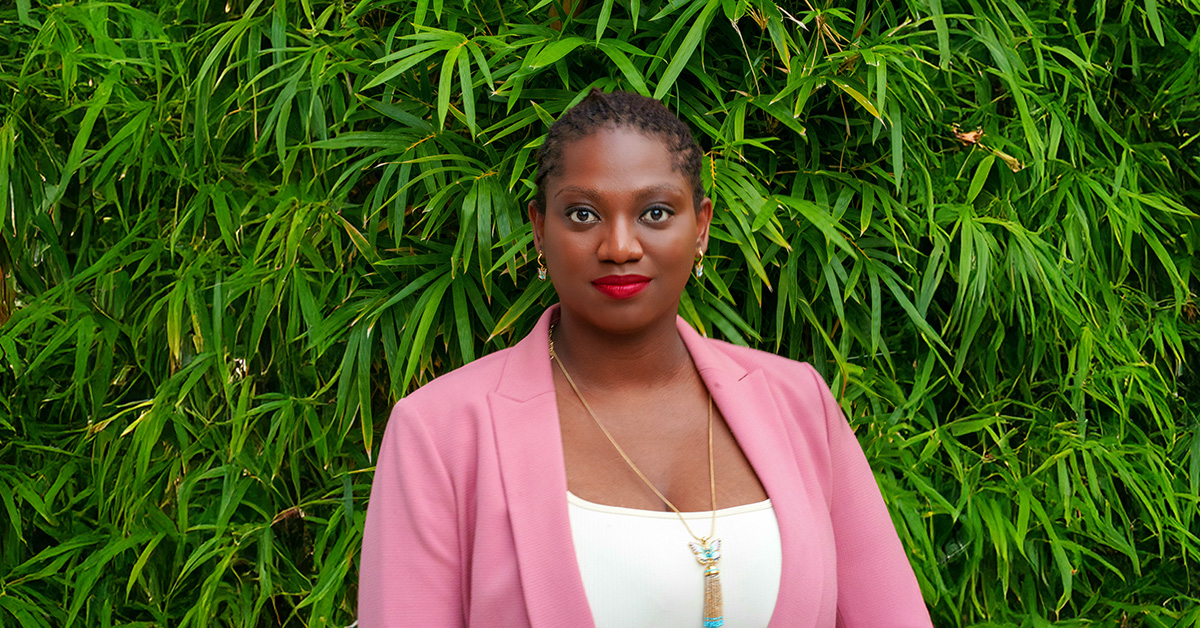

Naydine Johney, a 2019 graduate of Antioch‘s PsyD in Clinical Psychology on the New England campus, is currently the program director for a school health program in New York, where she manages clinics for the Office of Mental Health. “It’s a fusion of primary care on a school campus,” she explains, with the added benefit of mental health care. In this role she leans deeply on her training in clinical psychology, and applies this expertise to support children at school. In a recent interview, Johney shared her journey through graduate school, her diverse clinical experiences, the impact Antioch had on shaping her career, and her advice for current and aspiring PsyD students.
Can you tell me about the work you’re doing today, and how you came to it?
Right now I’m the program director for a school health program. I also have a small group practice that includes a psychologist and a social worker that I supervise, and I oversee the business operations as well. My clinical work is split between the two. In the group practice, I strictly see adults. As the program director, I see kids. I work with elementary age kids, but I supervise elementary, middle and high school. I currently supervise four providers and two outreach specialists and a Social Work Assistant. We collaborate with the medical provider and nurse on site, because it’s in a primary care setting as well as the school. Prior to that, I was in the NYC Health and Hospitals system where I completed inpatient, partial hospitalization, psychiatric emergency department and outpatient rotations. So that’s the past seven years.
Which treatment approaches do you turn to most in your work today?
This is not a clinical approach, it’s more of a professional approach, if that makes sense, but one of the things that has been really valuable coming out of the PsyD program for me is self-reflection. All the self-reflection papers—that, by year four you’re just like, I can’t stand them—they’ve been the most helpful in framing the way I engage clinically and professionally, and administratively as well.
In terms of therapeutic approach, I go a little bit back and forth. I’m EMDR (Eye Movement Desensitization and Reprocessing) trained. I’ve been using that as one of my go-to interventions for the past three years. I’m also PC-CARE (Parent-Child Care) trained, which is similar to PCIT (Parent-Child Interaction Therapy) but better. Think PCIT in seven sessions. It’s one of the best approaches I’ve ever come across. I’m certified in both of them. So if I’m doing anything trauma related, I normally use EMDR and trauma-focused CBT (Cognitive Behavioral Therapy), which is just a given for me, because naturally I practice CBT. A lot of DBT (Dialectical Behavior Therapy) skills, I practice out of that modality as well. If I’m doing trauma work, high-risk work, then those are the things I sort of gravitate towards. PC-CARE is very behavioral heavy, so I do a lot of that, it involves a lot of parent coaching. When I work with kids, most of the work is actually parent coaching. So it depends on which population I’m working with, and I kind of gobetween those to what would work best.
I am very flexible, clinically and administratively. When I practice, the first thing I do is a self-reflection piece: What’s coming up for me? What is the situation calling for? Whether that is something that is needed, wanted or more like a personal desire. Because sometimes the biases come into play, and we have to be really mindful of that. So technically, I would say I start with self-reflection and then dive into a lot of the evidence based modalities.
Is your current practice approach what you envisioned during grad school?
Not at all. I was just like, I’m going to be the CBT person doing the CBT things. And then I was just like, Oh, I’m going to do the DBT and CBT, and that’s it. Then I think it was because of a lot of conversations with Susan Hawes and Martha “Marti” Straus about my dissertation, that I started framing my clinical work into something that’s more relational. And then I found Relational-Cultural Theory (RCT), and that shifted my entire practice.
Now I try to just combine everything, to use what works best for the client I have in front of me. My style started shifting from all that structure. I pulled what I needed, when I needed it, and I found that to be a lot more effective than sticking to the fidelity of all the modalities. I’m also learning that students need the fidelity to learn, but in practice, people are not built like that. So I don’t practice that way. I practice based on need.
What drew you to Antioch for your PsyD, and how has Antioch helped shape your career?
I grew up in the Caribbean. Antioch had greenery. They had this berry bush, and I was just like, What? Oh, this is working. This is in the woods. I was not expecting winter, as someone who grew up on an island. It was brutal—but not at the time I visited! So the setting helped.
I had two interviews. I thought Ted Ellenhorn was so fascinating. I still think he’s very fascinating—and that was before I found out he was part of a band, a real musician. Then I met with Susan, and she was really cool. She had a white chair. I was like, I want to be an adult with a white chair in my office. They just seemed to be enjoying what they were doing. And I wanted to be in a place where I continue to learn and enjoy what I was doing.
I had some hard times at Antioch, particularly because there were only two of us who were Black in our entire program at the time. That was stressful in a whole different way. I think that sort of birthed my stance on cultural humility. I don’t believe in cultural competence. That’s very controversial, sometimes, depending on where it comes up. But I don’t believe in cultural competence. I don’t think you can be competent in that way. It’s a dream, right? Cultural awareness is a journey. I don’t think culture is like a snapshot, and you capture an entire culture. Cultures are always changing, evolving, growing into something new and something different. You can’t say you’ve mastered it at any point in time in your life. I don’t believe in being competent in that way. I believe in cultural humility and practicing from a space of always being willing to learn and recognizing that you are not the expert in everything—and definitely not the expert in something you have not experienced. That thinking was birthed at Antioch. It was just a mix of my personal experiences, professional experiences while there, the self-reflection, and so many self-reflection papers.
What kept me at Antioch: I could narrow it down to Marti’s reassurance and Gina Pasquale’s support. Those are the two things that kept me there. Marti just kept telling me, It’s fine. This is grad school. You’ll be okay. You’re doing okay. Then Gina started being Gina. She shaped a lot of my clinical work with kids. She has this thing, this aura, this Gina thing she does that sort of keeps you grounded just by being in the room. I found that very helpful and supportive. Then Marti was sort of my cheerleader.
Despite all of the hiccups and everything, I wouldn’t trade my experience at Antioch for anything else. I think it shaped me into probably the best version of myself, clinically. Also, when you go into the real world and you start practicing, Antioch is very thorough. You don’t realize that until you’re doing that clinical work. But they’re thorough. In the practicums you’re kind of still learning, but I can confidently say that most places, most spaces, when it comes to clinical work and even the administrative piece, I’m usually at an advantage because of the work I put in at Antioch, especially the self-reflection.
What advice would you give to new or prospective PsyD students?
Practical advice: figure out the finances early. Figure that out, or at least spend some time learning the true cost of education and planning to ensure that that expense does not hinder your growth post-education.
The other part is to be intentional in learning. Passive learning is one thing, but be present and intentional in your learning. That way you can truly enjoy the experience of learning. Grad school is very short. It’s going to seem like it’s forever, but it’s a short period of time. Create moments when you can genuinely enjoy the decision you made to invest in yourself by pursuing your education. Create opportunities for that and self care. Mine was going to the library and taking a nap—that was my form of self-care during grad school, napping. Standing outside and picking berries from the bush that’s there on the property. You can just eat it! That was my experience. Whatever you can do, do it, so that you have those memorable moments that are outside of the classroom and not just through the learning.