


This essay is part of Antioch Voices, a forum for Antiochians to speak out about issues important to them. Opinions expressed here belong to the author alone and do not necessarily reflect the official position of Antioch University. If you’d like to share your own voice, the first step is to send a short description of what you are planning to write about to [email protected].
A Snapshot Taken by Laurien Alexandre
In recent years I’ve heard a frustrating misrepresentation repeated far too often. It goes like this: ‘Antioch is NOW one University.’ As if… history doesn’t matter.
I see it a bit differently. My perspective is grounded in my 35-year Antioch journey of multiple identities. I hold a proud campus identity, having served as Academic Dean of the Los Angeles and Santa Barbara campuses for seven years. I have a powerful ‘central’ identity, having served as the University’s first Vice Chancellor of Academic Affairs for six years. And, I have a nationwide identity as the Founding Director of the PhD in Leadership & Change Program, and then as Founding Dean of the Graduate School of Leadership and Change, Antioch’s first (and only) non-campus-based national academic school for over two decades.
I believe recognizing multiple identities is healthy and, in this case, each of these identities matches iterations of Antioch University since it was established almost 50 years ago. They each bring ways of being that offer personal, professional, and organizational challenges and opportunities in serving our mission in different times and in different ways over many years.
To me, that diversity is our strength. We’ve been ONE University for almost 50 years.
One University: The College as the Center
Technically, the amended Articles of Incorporation to change the name of Antioch College to Antioch University were filed with the Ohio Secretary of State in December 1977, even though the bronze historic plaque standing on the College campus says 1978. I guess contestation starts early!
The University of that time was completely anchored at and for Antioch College, rooted in the College’s experimental expansion in the 1960s and 70s. While held together by the unifying mission and call “to win victories for humanity,” and while sharing a singular HLC accreditation, the ‘satellite’ locations were basically revenue-generating sites to support the College, which ran deficits for years. From 1985-1994, Al Guskin served as President of Antioch University and of Antioch College, and then from 1994-97, two separate positions were created. Guskin became the Chancellor of the University, Antioch’s first Chancellor. There was one University Board of Governors, primarily composed of Antioch College alumni.
During the first years of Guskin’s tenure, two of the last remaining far-flung network sites were closed in 1988, the Law School in DC and Antioch Philadelphia: leaving only Antioch Southern California, which consisted of both Los Angeles and Santa Barbara, Antioch Seattle, Antioch New England, Antioch Midwest (then known as Antioch McGregor) and, of course, Antioch College. These six locations constituted the campuses of Antioch University when I joined Antioch in 1991.
Bottom Line: Depending on where one sat in the University system, one might have seen the model benefiting the College at the expense of the growth potential and quality oversight of the campuses. Others saw the far-flung satellites as sucking the endowment of and diverting the attention away from the College.
One University: The Federated Model
From the 90s to the mid-teens, Antioch University transitioned to a federated model composed of semi-autonomous campuses (no longer “satellites”) living under one mission and one accreditation. While recognizing the College as the historic center, the non-Yellow Springs campuses became more-or-less co-equal operating units, sites of location-based teaching and learning serving vibrant, diverse communities across the country. The role of the College president separated from the University Chancellor. Campus leaders went from being deans and provosts to presidents reporting to the University Chancellor. The University had one fiduciary board. Eventually, campuses had their own local ‘advisory’ boards of trustees composed of campus alumni and community leaders.
In this federated model, campuses hired their own faculty and staff, offered their own academic programs and services (i.e. advancement, marketing, registrar, library). Each campus had a significant presence in its region, served the needs of its region, marketed to its region, created partnerships and philanthropy in its region, and developed strong community relationships, some of which continue to thrive today, such as Glover’s Ledge and the Community Gardens in Keene, or the Bridge Program in LA. While some campus programs, such as NE’s PhD in Environmental Studies or LA’s MFA, recruited beyond their immediate locale, most programs were location-based; some would say, geographically constrained, others might say geographically embedded. Campus enrollment goals varied for each, but typically were in the range of 2,000 students. Campuses paid ‘overhead’ to the University to fund central functions.
Interestingly, back then, the University Board actually encouraged each campus to buy its own building to create permanency and presence in its location. What was perceived as an anchor to thrive back then might well be considered a chain around Antioch’s proverbial neck today.
In 2001, the first (and only, for close to two decades) non-campus-based academic entity, the PhD in Leadership & Change, a geographically dispersed doctoral program, was launched. Not one of the six campus presidents at that time supported this untethered innovation because it broke the governing status quo of campus/president control, but we had a generous donor gift to support the program’s development, we had Board support, and we had a chancellor who saw it as part of the University’s future. The faculty and staff of the PhD Program were the first to live all over the country working from home offices (and students came from all states and around the world), meeting at quarterly residencies held on a rotating basis at the campuses. Glimpses into the future.
At one point, Jim Craiglow, who had been president of Antioch New England and then served as University Chancellor (2002-04), created t-shirts for us all that proudly proclaimed, “One University.” He held both campus and University identity.
“Central” positions were very few, limited mostly to the Chancellor’s Office, finance, and HR. Campus deans and staff reported to the campus president, not to a central administrator. Serving during this time as the University’s first Vice Chancellor of Academic Affairs (2006-2012), I can attest the role was more system-wide collaborator than central authority, bringing faculty together, for example, to create the first university-wide faculty handbook and policies, and to collaborate with the Blue Book Commission, which successfully secured three-year rolling core faculty contracts. We held annual University-wide faculty conferences. The West Coast campuses piloted sharing online undergraduate courses. Yes, things took time and decisions were often messy. Travel was extensive and expensive. Zoom didn’t exist. Yet we collaborated across one University in multiple and pioneering ways.
Sometime around 2013, Antioch established AU Virtual (I liked to refer to it as AU Connected), which was a University (central) initiative to offer undergraduate (and perhaps some MBA)courses online nationally. This eventually became AU Online, which existed until this most recent School reorganization in 2024-25.
The 2011-12 HLC Self-Study and Reaffirmation was our first without the College, which was closed in 2007 (to reopen as a separate institution in, I believe, 2011). We came through HLC with flying colors. We showed them with sound evidence that we were ONE University, structured around distinctive semi-autonomous campuses, held together by our mission and accreditation. The reviewers noted that wherever they went at Antioch (and they visited ALL campuses), they found “our DNA.”
Bottom Line: For much of this period, campuses thrived, innovation occurred, Antioch’s presence in regional communities grew. Faculty, staff, students, and alumni felt they were part of purpose-driven campuses of belonging. But the model became unwieldy in terms of governance, fiscal oversight, and internal program competition. Inequities and disparities existed within and across the system. While regional presence, philanthropy, and connection often thrived, enrollments were limited, a unified voice was absent, and we missed national opportunities for expansion and philanthropy.
One University: Centralized Model
In 2016, the University Board approved the Realignment Plan. The infamous “5-to-1” Board-mandated reorganization of many back-office functions started earlier than that. Eventually functions such as registrar, financial aid, student services, and so forth shifted to a centralized model. In many cases, that shift made loads of sense. Clearly, going from five different LMS’s to one would facilitate a more cost-efficient model and a more seamless student experience. In some cases, the outcomes remain mixed to this very day. The rocky and uneven nature of some of the centralization efforts created some of the friction. Antioch is far from a well-oiled machine.
The large-scale organizational realignment was pushed into overdrive when Bill Groves became Chancellor in 2016. Campus presidents were removed; campus Boards of Trustees were sunsetted. Revenue now belonged to central and funds were then distributed back out to campuses and programs to cover their needs. Central positions became the norm, and reporting relationships shifted from matrixed to centralized ultimately creating the leadership model we have today. Efforts to standardize processes and systems across the University took precedence over opportunities for incubated innovation at the local or program level. The value of the campuses was in many ways diminished, often viewed as troublesome and costly. Some in central administration even expressed in low voices, “The campuses should disappear.” Yet they survived, continuing to bring faculty, staff, and students together in community, albeit more limited.
Our mission continues to hold us together. And our strengths recently recognized by the 10-year reaffirmation of our HLC accreditation in 2025.
Bottom Line: Far better and necessary controls over spending are now in place. With our national schools—Counseling, Psychology and Therapies; Nursing and Health Professions; and Interdisciplinary and Professional Studies—the opportunities for learner access to AU programs has expanded across the country, and internal program competition across different campuses has been eliminated (for the most part). These and other changes have positioned Antioch’s growth and expansion in the Coalition for the Common Good (CCG). Meanwhile, legacy elements of the prior decentralized model still exist, often causing friction with the current dominate structural model. It has been difficult to create an institution of belonging when central is often faceless, campus communities dismissed as of little value, and local identity often viewed as resistant to change.
One University: One Mission, Many Places & People
We are no longer that One University linking satellite outposts to serve an historic college in the Midwest. We are no longer that ONE University composed of thriving semi-autonomous campuses – both in and out of control – in a federated system. We are/and are building One University designed as a centralized system, geographically dispersed, serving students nationwide in multiple modalities organized by national schools. And, we are a workplace that functions beyond place, drawing talent from across the country.
I believe, and remember, this is Laurien’s snapshot, that our “oneness” is enriched by our dispersed diversity, not our system singularity. I wonder if there is a way somehow to view Antioch University in 3D: The functions of central services, the delivery of our national schools, and the place of our campuses. Intersectionality at its best.
I believe we have the opportunity of One University with one mission and multiple identities. I am not naïve and I recognize that such an approach is messy, making one-size-for-all undesirable. But we may be missing a unique moment in this time for Antioch University to expand its mission, philanthropy, access, and impact.
Such an approach would challenge us to ask how to balance the need to standardize for cost-savings and efficiencies with the need to differentiate to serve pedagogies and peoples, the opportunities to be a national brand with the need to be a local name. It would mean seeing local and/or program-specific initiatives as innovation, not just irritation. It would mean considering possible differentiations as trailblazing pioneers rather than troublesome delays.
What if we considered building Antioch’s SSSO (System-Schools-Site Optimization) as we build the Coalition’s SSO (Shared Services Organization)? What if there are ways to see local presence as fueling School power, and campus life co-existing with Central authority? What if there are ways to see Antioch’s power separate from and yet embedded within the Coalition for the Common Good? I believe it is possible to think globally and act locally, and similarly to think locally and act globally; in other words, to think University and act campus; to think School and serve region; to think System and honor site.
Perhaps our competitive strength, both fiscally and academically, is that the One University of today can be Both/And: centralizing services, making optimal use of modalities to deliver programs that are both nationwide and potentially region-specific, and honoring the value of mission impact in local community as we strengthen our presence across the nation.
I don’t pretend to have the answers to these questions nor the blueprint for the future of the One University of 2025. But I do think these are some of the challenges and opportunities facing Antioch’s leadership, be they in central administration, at campuses, or present in our geographically dispersed teaching and learning ecosystem.
Bottom line, Antioch has been One University Under Mission for 50 years. What will it look like going forward?
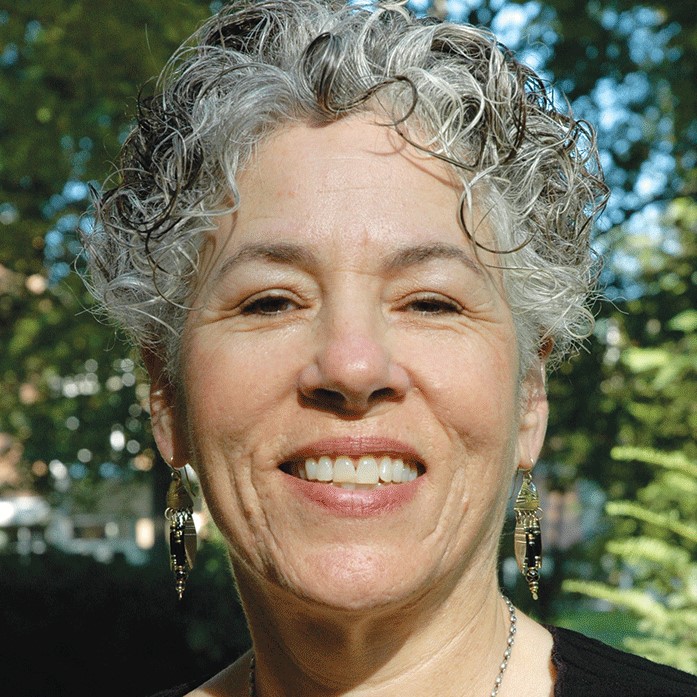
Laurien Alexandre
Over her 35 years at Antioch University, Laurien Alexandre, PhD, has held positions ranging from Academic Dean of Antioch Southern California and Founding Director of the PhD in Leadership & Change to Founding Dean of the Graduate School of Leadership & Change and Vice Chancellor of Academic Affairs. After stepping away from the Graduate School in 2024, Laurien has been working on University-wide communication efforts for Antioch and for the Coalition for the Common Good. She lives in Los Angeles with her husband, Henrik, and Labrador, Puni.