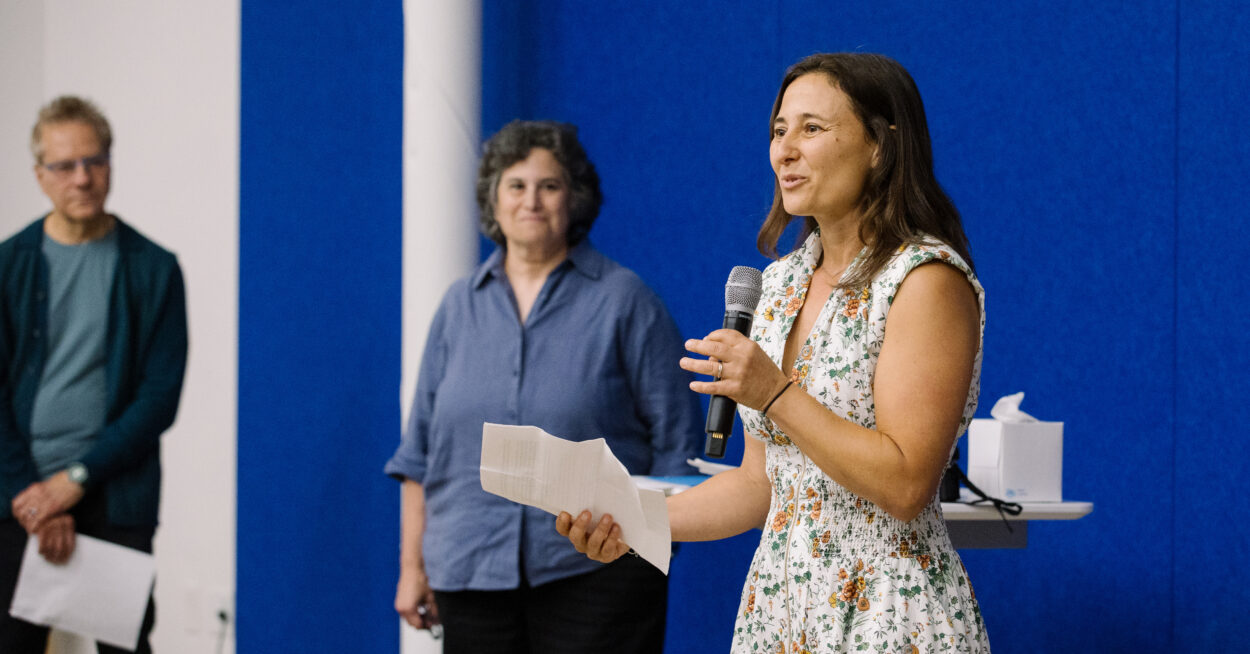

For almost two decades, Ileya Grosman has been at the forefront of reimagining education through the lens of connection and care. Grosman, a 2024 graduate of Antioch University’s PhD in Leadership and Change, is both a researcher and an educator. Her work explores how mutuality, intentional presence, and embodied practices can transform classrooms into spaces of trust and empowerment. Her dissertation, The Pulse of Connection: Professors’ Experience of Positive Relationships with Students–An Interpretative Phenomenology and Photovoice Study, integrates arts-based methods like PhotoVoice to highlight the ripple effects of mutuality and positions Relational-Cultural Theory (RCT) as a transformative framework for addressing systemic challenges and cultivating cultures of care in higher education. In a recent interview, she shared the relational depth of her work, offering insights into how her findings challenge traditional power dynamics in education and how she hopes to use it to advocate for relational approaches that foster growth for both professors and students.
What drew you to use Relational Cultural Theory (RCT) in your dissertation, and what key aspects of it did you want to highlight?
I have a 20-year history exploring connection, but it wasn’t until I entered the PhD in Leadership and Change program that I found a community also exploring connection. When Harriet Schwartz, PhD introduced RCT to my cohort, it was like so many light bulbs were turning on. I began to feel like I belonged, in the sense of mattering. I realized there was a community that believed we are deeply connected, and I was part of it. It was an embodied sense of understanding what I had been trying to explore on my own in my study and professional practice.
You write about “the space between,” and the way teachers can recognize students as a source for their learning, versus the traditional model where students are supposed to be only receivers of knowledge. Can you talk a little about “the space between?”
Yeah, I mean it’s twofold. One, we have responsibilities as educators, right? We have a responsibility to grow the student. But that’s not all of it. The responsibility is to recognize our power and our authority in the space. The way our power can be used can be a power-over—we can deposit knowledge into these students and expect them to take it and look down upon them if they don’t. Or, we can say, Wow, what else could we do with this power? I believe that, enlarging the conversation into leadership in general, we have a responsibility as educators to look at the space and know how we may be influencing the space. With that in mind, recognize that no matter what, we are always being influenced in that space. That is an opportunity to start looking at power as a power-with. And that space between a student and a professor, is to understand that, yes, I have responsibility as an educator to provide a space where hopefully they learn, and I’m giving information for them to play with that hopefully helps increase their knowledge base, and also, What am I doing to cultivate a sense of care? And in response, What will allow them to feel open enough to share their story and their experiences and their thoughts?
There is an ever-evolving opportunity and space for both of us to be growing as humans, as emotional beings, to be growing our sense of care for another and growing our own empathy.
I’m only going to be as good as my students are willing to share, but it’s my responsibility to cultivate a space that will allow that to happen. I’m thinking about Adaptable Leadership Theory, what Ronald Heifetz calls the balcony and the dance floor. As an educator, I have to be on the balcony, understanding how I might be influencing the space, holding the responsibility. I also have to be in it, and I have to be dancing with the students. That space between, that dance, is where a lot of magic can happen. I am in two roles at once as an educator. I believe that our responsibility in education is to recognize our power in the space—and how we can cultivate an interconnective experience.
You used the participatory research method, PhotoVoice, as a way to empower participants to document their experiences through photography and then share about an image through narrative storytelling. I found your use of this method compelling, specifically in pairing RCT with an aesthetic lens. Can you tell me a bit about your choice to use PhotoVoice as a method?
It really stemmed from the edge of where I felt RCT kind of stopped. Relational Cultural Theorists beautifully use language to try to capture what connection feels like. But it wasn’t there yet. As someone who is an artist, a photographer, and has worked with students that must use their bodies to connect, it just made sense to move into the arts and photography. I believe photography to be a democratized, or let me say an accessible, art form in today’s world. The research has shown that even in small, remote areas in the world, phones have become much more accessible than, say, a digital SLR, which is a heavy camera. I’ve seen this through my own travels as a photojournalist, that phones are becoming almost as common as a pen and paper. With phones now we have the built-in lens. Of all the art forms, that was the one that I felt was a strong conduit for connection.
The beauty of using art in general, and particularly with photography, is that [holding a camera] is as similar as holding, say, a rosary or Buddha prayer beads, right? You are touching something that symbolizes something very deep and hard-to-capture. So in the course of interviewing, I wanted to have the capability to always refer back to something we were physically looking at. Anytime we had to do that, there seemed to be a moment of pause, and the participants would always touch a part of their body that resonated with them. It was usually their chest, or their throat, or they would just pause and close their eyes. That’s what I was hoping for, that I would see connection. That’s why I wanted to use an art form that was tangible and somewhat relatable instead of that feeling of, I can’t draw, I can’t paint, you know? I wanted to bring people back to the most basic concepts of connection, the most basic human humanness, which is that this whole world is deeply connected, and it’s a matter of understanding it through a lens that a person could relate to.
There’s a part in your dissertation where you’re talking about the first time you were listening all the way through to the recordings of the participant’s interviews, and while you listened to the interviews you were throwing clay as part of your embodied research practice. It surprised me, because I had never considered the intentionality of doing that. Can you share advice for folks who are considering having an embodied element to their work in their own PhD journey?
I was extremely intentional about chapter three, which is what you’re asking about. I really wanted any possible dissertator or just researcher to look at chapter three as another way to be doing research, as another way of understanding that you are being influenced by what’s happening in the space of a participant or a co-researcher, but then [you’re also affected by the spaces you conduct research in when you’re] away from them. By engaging in, or just even being cognizant and aware that you are touching the keys when you type, or that you are going for a walk to just pause, which is really your body digesting the information—that is a practice of research.
This whole dissertation was so intentional about modeling what connection looks like, and that it can happen, and that it can be different for everyone. This is one way. Our physical movement being recognized and not separated from our thinking can be very powerful and deeply spiritually connected back to the work and the mission as to why we might be doing the work. For me, this is a social justice practice. This is a practice of how we are transforming a world to be living through connection more than disconnection, because they’re both happening all the time.
If there’s one thing that I would want dissertators and fellow researchers to take away, it’s that whatever you do to function, recognize that there might be good reasoning behind it. And let’s hope that you’re not pushing that away, or that you’re trying to assume that that’s an isolated experience from the research process. It is all deeply connected. That’s why there’s a lot of photographs, a lot of images of my drawings, and a lot of writing in my dissertation that is extremely metaphorical. It’s a reminder that our lives are very cyclical. Our experiences are interconnected and influence each other.
You mentioned zest and clarity as somatic cues for feeling connected. How do these sensations align with RCT concepts of growth-fostering relationships?
I just wrapped up a course that I built from the ground up for the University of Denver called Leadership Principles. We used connection as the framework that we were going to look at leadership through. One thing I brought up quite a bit in my activities with the students is, How do you notice that you’re connecting with the person next to you? We would focus on the arc of empathy. When you’re listening, you’re not just listening for words, or listening for how their body’s moving, you’re also aware of their dignity, and you’re aware of the humanity in this moment. When we talk about zest and clarity as a growth-fostering concept, these are signals. Kind of like when we’re driving, we have stop signs and we have road signs. They are signals that we’re heading in the right direction. There are these signals that we are there, and there are signals that mutuality is forming or has formed. Because there’s growth happening, these things are happening.
How does that play into the conversations surrounding the responsibility of professors to establish a culture of care?
An activity I taught this quarter was understanding your values and understanding that those values create your boundaries. That did come up in the study as well, at least in my discussion around when we can understand boundaries are an act of “community”—that they’re a place of creation. Boundaries become an act for community. It’s not to separate us. It’s to know where we can meet each other so we can grow, trust, empathize, and connect.
What I would say to fellow professors and fellow educators is that this is a deep dive work into self, but it is also understanding that you have to interact at some point, you can’t just wait until you feel you’re perfect, whatever that means. You have to be aware in the moment of the visceral experience of what’s happening, and know that there are professional boundaries that have to be kept, but that doesn’t mean you have to be cold and closed off from your students. Instead, know those boundaries so you can go to them, you can get close to them. It gives you an opportunity to be the student, too, and allows them to open up more and be more vulnerable. If we can have a better understanding of who we are, how we’re presenting, but also prepare like hell and get ready to flow in the space, then we may have the opportunity to be more present and connected to our students.
Can you explain a bit about what Intellectual Mattering is, and how it may manifest in a professor-student relationship?
Intellectual Mattering is awesome. From Dr. Schwartz’s work, it’s something I just absolutely love. Generally, Intellectual Mattering is when a professor takes an opportunity where positive vulnerability can really be used well, and says, Wow, student, you just said something that made me think a little bit. This can hopefully become more normal in the educational environment, where a professor can kind of say, Wow, you made me think. That human acknowledgment of another creates connection, right?
How can RCT principles be applied to navigate challenges in the professor-student relationship? Specifically, how can it address systemic bias and prejudice in higher education, and empowered dynamics within a professor’s relationships with students?
We have to remember that everyone is going to be looking at the world through their eyes and their experiences. And that is the truth. My truth is my truth, and your truth is your truth. We have that first layer of these relational experiences that create patterns and images in our minds that decide and that lead how we’re going to go forward based in our truth. I might have a truth, but I’m also the one in charge.
Professors are in charge. They have the power to assess where students learning is through grading. RCT understands that our social construction is different for each of the multiple people in the classroom, and as teachers we’re using power as a mechanism for connection. I think it creates safe guardrails to engage with healthy vulnerability. Listening, not always talking as the leader in the classroom. The professor acknowledging humans in the space and then also being very clear.
Clarity is something that comes up quite a bit in my research, and something I would like to really stress is that clarity is really an important piece of building the foundation of trust between a professor and student. That could be how an assignment is written. It could be posting when your office hours are. You could just have time to be accessible and open for students to ask questions for clarity and allow you to practice how to be clearer. These are all important principles. Also: calling yourself out when you notice that your biases have come through, and you didn’t even know they existed. That’s another moment of healthy vulnerability.