


This essay is part of Antioch Voices, a forum for Antiochians to speak out about issues important to them. Opinions expressed here belong to the author alone and do not necessarily reflect the official position of Antioch University. If you’d like to share your own voice, the first step is to send a short description of what you are planning to write about to [email protected].
I dreamed Horace sent me a message about immigration last night. Six powerful words.

Couldn’t be clearer. Antioch rises in an inclusive democracy. That’s been Antioch’s original
purpose since our founding in 1852. And that’s been Horace’s message across time and place. It gave me pause. Maybe he felt it was time to connect again. My last one-on-one with Horace focused on his thoughts about such dangerous words as diversity and inclusion happened back in February 2025.
Since then, ICE has brought unfathomable terror to families across this country. Masked, armed
and unidentified enforcers roam city streets looking for people of color to brutalize, throw into
detention camps, and then herd onto planes destined for unknown locations. Disappeared. With whistle-blowers in Chicago, green frogs in Portland, and neighbors protecting street vendors from New York to Los Angeles, it is no wonder we’ve caught Horace’s attention. As a staunch advocate for education’s essential role in an inclusive democracy, he surely has been watching as university faculty and administrators deliberate on how to protect the sacredness of their calling and the lives of those inside their halls. I knew Horace was reaching out because he wanted to make sure his voice was being heard, again.
So, let’s remember, Horace was a staunch believer that a democratic society thrives on inclusivity. Given his own humble background as the son of farmers, he would never have condoned xenophobic assaults on the poor and immigrant. He would never have allowed words such as “shithole,” “garbage,” and “invader” to be uttered in Antioch’s classrooms let alone in the halls of government. The verbiage of exclusion is a tactic of bullies and authoritarians. It goes against everything Horace stood.
Horace advocated for universal, free, and non-sectarian education as a means to provide equal opportunity for immigrant children, integrating them into the American identity and workforce, and fostering national unity amidst rapid demographic change. In essence, he viewed mass immigration as a powerful force that required a strong public education system to mold diverse populations into a cohesive, democratic republic.
To tell you the truth, much of Horace’s 19th-century assimilationist approach makes me cringe as I am a contemporary believer that our national unity is fundamentally grounded in that very
diversity. But, I do get where Horace was coming from. I can recognize the humanity and dignity that underscores his vision. For him there was no ‘othering.’ It was all about belonging.
Horace Mann (1796 to 1859) obviously didn’t experience in real-time the successive waves of mass immigrations that shaped this country. The very foundation of this country rests not only on the successive waves of voluntary global migration but also on the forced enslavement of African peoples who were central to the nation’s creation. The first big voluntary wave (1840s to 90s), was mostly from Germany and Ireland; then the next wave (1890s to 1919), was primarily from Eastern and Southern Europe. The wave in 1960s through turn of the century was mostly from Latin America and Asia. Nor did Horace experience the many successive brutal backlashes simmering below the surface ready to be emboldened by xenophobes. While he didn’t live through those times, his advocacy as an abolitionist and as a believer in education as the “great equalizer” for a functioning democracy tells us exactly the role he would have played and where he would stand today.
Decades after his death, Horace’s message spread across time and place, evidenced in its presence in many of the most powerful movements of resistance against this country’s demonization of ‘the other.’ During World War II, for example, while other universities closed their doors to Japanese American students in compliance with unjust policies, Antioch offered special scholarships allowing them to continue their education, showcasing our opposition to race-based discrimination.
Interestingly, the threads across one inclusion-based movement to another are not only symbolic but literal. Perhaps the most famous of the Japanese-American students who received an Antioch scholarship was Maria Sabusawa, later to become the wife of the famed novelist James Michner. She and her family were forcibly relocated to an internment camp, which she later described in terms reminiscent of today’s America, “Easter Sunday, 1942, my family and I were sent to a concentration camp. In spite of our citizenship, we were treated as enemy aliens because of our Japanese ancestry.” Fortunately, within weeks she received a scholarship to study at Antioch College, where she spent two years and eventually chaired Antioch’s Race Relations Committee. In a rare glimpse at the literal links from one justice movement to another, Sabusawa raised scholarship funds to attract Antioch’s first Black student in the modern age, future author Edythe Scott Backus, who in turn recruited her sister, future civil rights icon, Coretta Scott King. Sabusawa later went on to help found the American Council on Race Relations. Enough said. That Martin Luther King, Jr. graced an Antioch commencement in 1965 was not a fluke. There was a threadline across a century. He concluded his speech telling Antiochians, “There are too many silent onlookers. In the words of the first President of this College, the great Mann, “Be ashamed to die until you have gained some victory for humanity.” This means becoming involved in all of the struggles to make this nation, to make this world better. It means that we must develop a sort of divine discontent.” I bet Horace smiled down.
The next decade saw the government’s wrath brought down on Antioch College for its advocacy and activism. In False Witness (1965), a McCarthy paid-informant’s memoir published years later, Harvey Matusow detailed how the U.S. government hired him to investigate Antioch “not to convict it but to destroy it. Antioch was a school set up by Abolitionists, and now the modern investigators were trying to abolish it.” Clearly, they failed to destroy the abolitionist spirit of Horace. Kings Fall. Antioch Rises.
Some say the dead can communicate through whispered names. Maybe Horace wanted me to find another hidden connection when he sent me his late-night message. Could it really be as we moved into the 1960s, that the father of famed civil rights activist, Julian Bond, was actually named Horace Mann Bond. And, Julian’s full name was actually Horace Julian Bond. The spirit of that old White abolitionist lived on re-arising in the nation’s Civil Rights movement. Julian went on to help establish the Student Nonviolent Coordinating Committee (SNCC). Antioch College served as a base for SNCC-related activism, with Antioch students participating in crucial events like Freedom Summer, and the Antioch ethos fostering generations of activists to challenge racism through direct action, voter registration, and community organizing in the South. I am one of those successive generations.
Horace lives on. It isn’t in name only. His six-word message speaks volumes.
I have absolutely no doubt that Horace would oppose with every fiber in his being the current
immigration, or should I say, anti-immigrant policies, as contrary to the very principles of
democracy, human dignity, and the common good. Separating migrant children from their families, terrorizing neighborhoods, denying education to the undocumented, or cutting funding for schools in immigrant-heavy communities would horrify him. This is not the nation he fought for.
Similarly, offering golden visas to those who can bribe their way in, removing obstacles to access for Whites Only, and barring entry to those who speak their minds or have skin the color of the sun, is not only incredibly crass but racist and elitist to the core. Horace believed in uplifting all members of society, not violently excluding nor preferentially including based on national origin, religion, class, or status. Dreamers should be empowered to dream. That is what Horace would say. And Antioch should help them.
While I imagine, given his own race, gender, and position, Horace respected the rule of law, I can’t but believe he would have prioritized moral justice over ICE raids, detention camps, and illegal deportations. Where there is no dignity, there is no democracy. It is as simple as that.
So, I think Horace reached out this morning to remind me what it means to be an Antiochian today. I know there is a difference between an institution and an individual, between Antioch and Antiochians. As individuals, we must do what our conscience drives us to do. It isn’t for Horace to tell each of us what to do, other than to act on the principles of inclusion, justice, and equity and to “win some victory for humanity.”
In terms of Antioch, universities far bigger and wealthier than Antioch have fallen short, lost their way, and bent over. But others have joined together to file lawsuits that challenge federal
immigration rules and student visa revocations. Many have been in positions to reject restrictive measures tied to federal funding. University leaders across the country are working with state and national boards to advocate for fair and just legislation. Those are all choices of Boards and presidents who have to weigh the threats and consequences as they stand up for education’s role in an inclusive democracy. Horace would applaud them.
On a more immediate scale, Antioch must do everything it can to protect the rights of its employees and students, no matter their legal status. While we have distributed “Know Your Rights” materials, perhaps we should offer workshops on what to do if approached by immigration agents. We will continue to adhere to FERPA regulations and be sure that a student’s personally identifiable information is not disclosed without written consent or a court order. Antioch will continue to be a bold and powerful public voice to host discussions and projects that strengthen inclusion and civil discourse, like our Antioch Works for Democracy campaign and our new Office for Equity, Belonging, and Culture, as it works to build an inclusive learning community. Antioch’s curriculum, no matter degree level, discipline, or modality, should incorporate as appropriate the values of democracy, equity, and the common good, training professionals as democratic citizens to further the well-being of all communities. We cannot let up. These are the values upon which this University was founded.
That is what Horace was trying to tell me in his message last night.

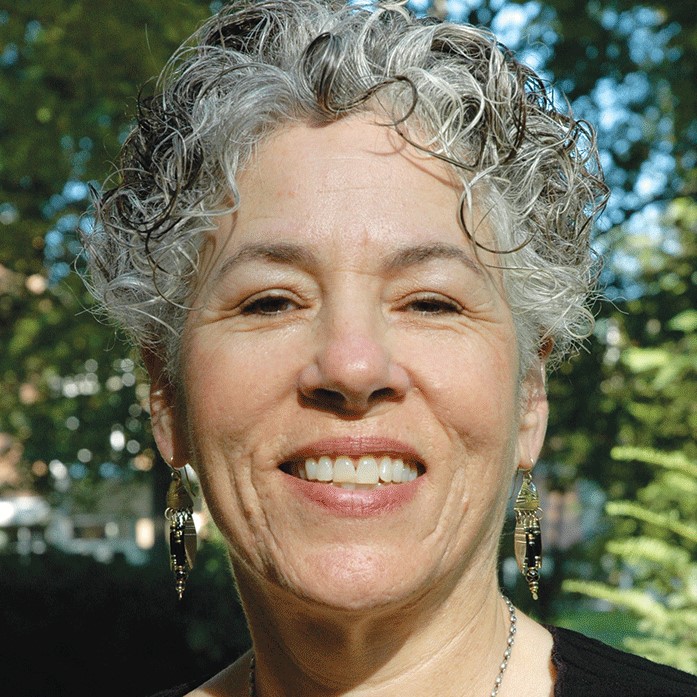
Laurien Alexandre
Over her 35 years at Antioch University, Laurien Alexandre has held positions ranging from Academic Dean of Antioch Southern California and Founding Director of the PhD in Leadership & Change to Founding Dean of the Graduate School of Leadership & Change and Vice Chancellor of Academic Affairs. After stepping away from the Graduate School in 2024, Laurien has been working on University-wide communication efforts for Antioch and for the Coalition. She lives in Los Angeles with her husband, Henrik, and Labrador, Puni. And, apparently, she has spent time communicating with Horace!