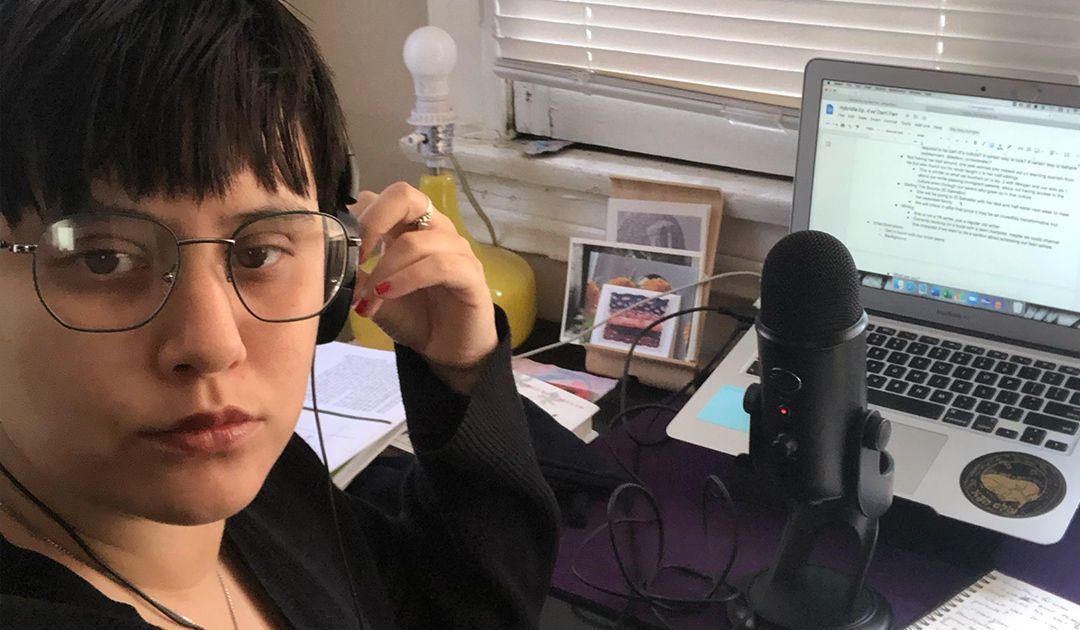
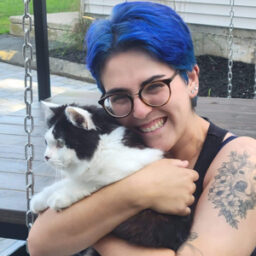
Kirby Chen Mages is a writer, performer, visual artist, and podcast host based in Los Angeles. Their work largely takes up questions of intersectionality, nuance, and how culture and identity are in conversation with one another. A 2022 graduate of Antioch’s MFA in Creative Writing, they recently wrapped up the first season of the podcast they cohost: Hybridia, which focuses on intersectional identity and artmaking. They sat down with Common Thread to catch up on their latest creative projects, including their podcast, as well as to reflect on their time as an MFA student at Antioch.
Your podcast Hybridia focuses on interdisciplinary art and intersectional identities—a really rich subject. Why did you choose to frame it this way, and what inspirations did you have
It had been an idea for a long time. I felt this curiosity to talk to other people who found themselves in some sort of intersection of identity. To begin with, it definitely was more focused on people who come from multiracial backgrounds. Then there were the Atlanta spa shootings, and there was all the Stop Asian Hate activism that was emerging. I had a friend who suggested I get in touch with someone I had gone to college with because I was feeling very emotional about things that were happening at that time. My friend suggested that I reach out to our friend, Saki, because she’d been feeling similarly. We started having these conversations, and I confessed to Saki that I’d had this idea for a podcast in the past, and that for some reason, she’d always kind of been in my mind as someone that I could imagine doing it with. I felt like we had a comfortable rapport, and we’re interested in similar things. It just kind of blossomed from there. It was also during the pandemic, so we had a lot of free time. It helped us have structure outside of everything else that was going on.
The first season was strange, too, because we recorded it over so many years, which wasn’t the intention. The second season is going to start being released in September, and that’s going to be much more real-time, releasing the episodes within a month or so of interviewing our guest.
I listened to the episode where you interview a fellow Antioch MFA alum, Ahsan Butt. He talked a lot about his childhood, growing up Muslim, and navigating that identity in the writing world. Why did you choose to interview him, and was there anything from the conversation that stuck with you?
Ahsan and I started at Antioch the same year. We were the first Covid class—June 2020—so we were the guinea pigs of how to do everything on Zoom. Ahsan and I just immediately connected over a lot of things. We were both on the translation team for Antioch’s literary magazine Lunch Ticket, and he became one of my closest peers at Antioch, though we had never met in person.
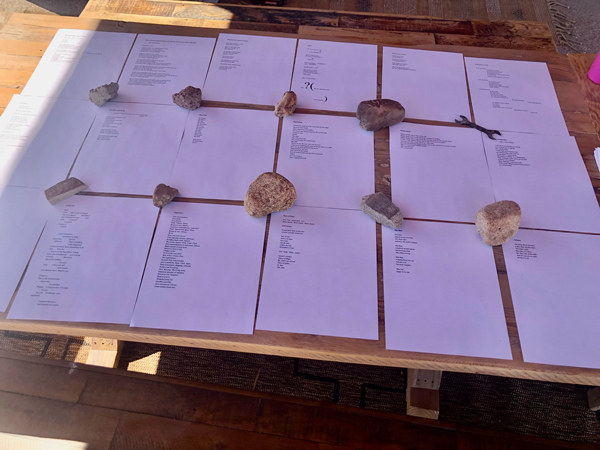
He seemed like a perfect person to interview for the podcast, because I love the way that his mind works. I just knew the conversation would be good. It’s one of my favorite episodes, because I feel like we get very deep into this idea of being ‘the other’ from an artistic lens and how it shapes the way that you pursue your artistic visions. I still hadn’t met him in person during that interview, but he was living in Chicago at the time, and I’m from Chicago, so I went to visit family, and we finally got to meet in person after knowing each other for, like, five years. So that was really special. I thought it would feel a little stranger than it did, but we were already so familiar with each other that it felt very natural.
Between the podcast, writing, and publishing, as well as performance and visual art, you seem really busy. How are you balancing all of your creative work right now?
Oh, my God. I wish I had a creative answer for this question. It’s really just keeping a very detailed planner, blocking out certain things. I’m definitely always working on that muscle of saying no when you want to be social, but you have to work on a project. It’s getting over the FOMO and hunkering down.
Also, I’ve started becoming very focused on, at the beginning of the year, I map out the main projects I want to see through for the year. I know there are other things that I want to work on, but I just have to table them for maybe the next year. You can’t do everything all at once.
What does a typical day-in-the-life look like for you?
I have a day job. I work in production, so that kind of structures my day. I work from home, and I
don’t remember who it was who said that the ideal job for writers is some kind of desk job. My job is very predictable and it doesn’t take a lot of mental energy from me, so I still feel that I have the resources to use towards my own creative pursuits.
I do really prioritize friendships, as well. There’s not a day where I don’t have a really meaningful check-in with a friend, whether that’s in person or on the phone. I think it’s a very grounding thing for me, day-to-day, being connected to my community. I think it’s good, too, when you know your friends are also working on a lot of solo stuff, to just check in and see how it’s going, and to have a dialogue with each other about what you’re working on.
How does self-care fit into your day-to-day life?
That’s also something I have learned to really prioritize. I have hard lines about certain things, like almost every day I take a 20-minute nap at the end of the work day. Again, checking in with friends and taking care of your mental health if you can. I’m a huge proponent of somatic therapies and other talk therapy—making sure you have a place to process what’s happening in your day-to-day.
In the Spring of 2023, you were part of Antioch’s “Messy Conversations” and discussed National Poetry Month and the experience of being a BIPOC poet. What felt most salient and important from your participation in that event?
I remember it feeling like the first time that I had been at an Antioch event that was specifically for poetry, the reading of poetry. It was really nice to just be with other poets and get to hear some other people’s work. And you know, the conversation that we had after the reading was so fruitful. It was just very open. When I do find time to attend, I’m always really blown away by how candid people are. I think the title of the series makes it feel like a safer space to talk about things that can sometimes be uncomfortable. I think that’s part of why I love being a part of the Antioch community, because there’s a place to talk about some of these things in a deeper way than you can in other institutional spaces.
Speaking of Antioch, I’m curious about what first drew you to come to the Antioch MFA?
I was working a desk job at the time. I was working in person in Culver City, which is where Antioch’s Los Angeles campus is. I had some downtime at the desk job to kill, and I was maybe writing a little bit on my computer. And I remember that I hadn’t been actively writing as much at that time. I started thinking, ‘Well, maybe if I get a Master’s, I’d get back in the swing of things.”
Honestly, I just did a Google search of the best low-residency MFA programs because I knew I couldn’t leave my job at the time. Antioch was on some list of ‘Top Five Low Residency Creative Writing MFAs.’ I honestly hadn’t heard of it before, and then I saw that it was in Culver City, less than a mile from where I worked. I remember thinking, ‘Oh shoot, this seems meant to be.’ Then, on top of that, I saw that Victoria Chang was the current chair of the writing department, and I loved her poetry. It all felt like it was very meant to be.
Are there particular moments during your MFA that you felt were most impactful in your growth and development as a writer and artist?
I’m remembering a talk that Victoria Chang gave about the life of a poet. It all kind of came down to her saying at the end, ‘We always have to remember that poets suffer.’ It felt comforting to have the then chair of the department being so honest. There was no sugar coating. It was very much, ‘This is the life of a poet if you choose this life.’
In general, that first residency where we got to be on campus was so incredible—what it was like to just see all these faces that I had seen on Zoom for such a long time. We got to physically be together in the same space. I’ve learned that I really needed that intentional literary community Antioch offered. I come from a visual arts background, and I have a lot of lifelong friendships from that time in my life, and we check in with each other and all that. But the literary community is very special, because I feel like it’s much more collaborative. It’s such a solitary act to write, but there were so many writing groups, reading groups, places to hold accountability. I learned a lot about community building in that way.
For those considering an MFA or for those feeling more serious about publishing and showcasing their work, is there anything you wish you knew when you were first starting out?
I mean, it’s something that maybe you can’t know until you go through it. And I’m sure I had so many mentors tell me this, too: you have to learn to accept, especially with writing, submitting and then receiving rejections. Just learning not to take the rejections personally. I think one good way of figuring that out was by being a reader on Antioch’s literary journal, Lunch Ticket. That was so informative for me, because you see how many submissions there are. It’s like thousands of submissions sometimes. You learn not to take it as personally when you submit something and get the inevitable rejection letters.
Another thing I really appreciated about Antioch was that they gave a lot of practical seminars and advice around publishing. I think you can learn that stuff outside of getting an MFA, but if someone is considering Antioch as a program, that’s a big focus, which I appreciated.
–
Learn more about Kirby Chen Mage’s work on their personal website.
Visit the program page for the Antioch MFA in Creative Writing.